
Exfoliating-Toner Stinging: Label and Routine Checks
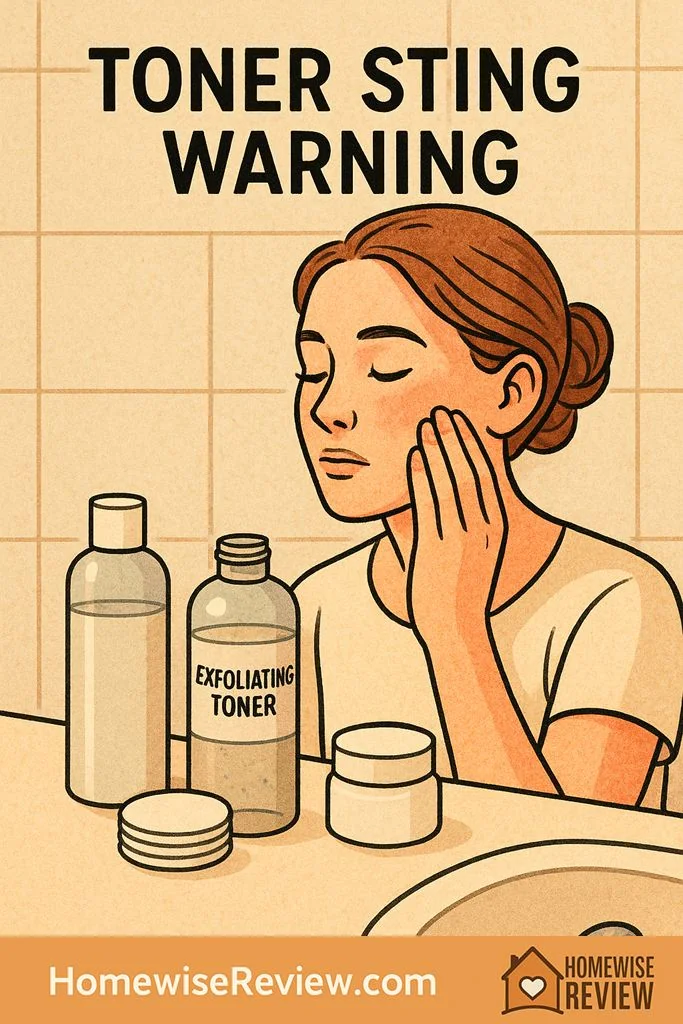
Read exact acid-toner directions and irritation warnings. Compare permitted areas and routine conditions without diagnosing barrier damage, ranking tolerance by percentages or inventing a gentler Byoma winner.
Stinging after an exfoliating toner is not a measurement of how well it works. It also does not identify a damaged barrier or a particular ingredient from the sensation alone. Read the exact product’s directions and irritation warnings before deciding whether another toner is the answer.
The American Academy of Dermatology’s exfoliation guidance says exfoliation is not suitable for everyone, advises against exfoliating open wounds or sunburned skin, and notes that existing products such as retinoids or benzoyl peroxide can affect how skin responds. If you have questions about whether exfoliation suits you, it recommends a dermatologist’s evaluation.
Compare instructions, not an acid-strength league table
This guide checks four named formulas and their current manufacturer information. It supplies no personal tolerance test, complaint-rate ranking, diagnosis or comparison proving that one causes less stinging than another. AI assisted the research and writing.
| Product | Documented identity | Buying limit |
|---|---|---|
| The Ordinary Glycolic Acid 7% Exfoliating Toner | Exact 7% glycolic leave-on offering | No sensitive/peeling/compromised skin; eyes avoided; irritation rinse/stop/physician |
| Pixi Glow Tonic | US 250ml offering identifies 5% glycolic acid | Named cotton-pad method avoids eyes; percentage does not rank tolerance |
| Paula’s Choice Skin Perfecting 2% BHA Liquid Exfoliant | Exact 2% BHA Liquid, separate from pads | Eye avoidance; upperfrequency conditional on no irritation; salicylateallergy caution |
A percentage identifies a stated concentration in a named formula. It does not create a universal tolerance ranking across different acids and complete formulations. Daily-use marketing is also not a reason to continue using a product despite its irritation warnings.
The Ordinary Glycolic Acid 7%: read the restrictions
The current Glycolic Acid 7% Exfoliating Toner directions specify face and neck application with a cotton pad or fingers, once daily, ideally in the evening. They say not to rinse during normal use, avoid the eye contour and eye contact, and not use on sensitive, peeling or compromised skin.
The directions distinguish normal leave-on use from an irritation response: if eye or skin irritation occurs, rinse thoroughly, stop use and consult a physician. They also include an AHA sunburn alert, with sunscreen, protective clothing and limited sun exposure during use and for a week afterwards.
These named restrictions matter more than choosing a schedule from a generic toner article. Do not borrow its scalp method for facial use or infer that a lower-priced bottle requires fewer label checks. No comparative stinging advantage or disadvantage is demonstrated here.
Pixi Glow Tonic: keep the exact method and percentage together
The US Glow Tonic 250 ml page identifies 5% glycolic acid and describes use in the morning and/or evening, daily or as needed. Its method follows cleansing, uses a saturated cotton pad across face, neck and décolletage while avoiding the eye area, and follows with serum or moisturizer.
That is a manufacturer method for the named product, not a prescription for every reader. The stated concentration does not prove less stinging than the Ordinary’s 7% formula. Nor does alcohol-free positioning establish compatibility with your current routine.
Use the warnings on your exact package. A product described as glow enhancing or suitable for daily use still needs to be assessed by its permitted areas and instructions. No clinical conclusion about a witch-hazel reaction or botanical sensitivity is established here.
Paula’s Choice 2% BHA Liquid: retain the irritation condition
The US Skin Perfecting 2% BHA Liquid directions specify clean skin, hands or a cotton round, avoiding the eye area, leaving on and following with the rest of the routine. The stated upper frequency of twice daily is conditional on absence of irritation. Daytime use includes sunscreen guidance.
The brand also advises people with a salicylate allergy to consult their physician before using salicylic-acid products. This is an exact manufacturer caution, not a diagnosis supplied by the article.
Keep Liquid distinct from separately named pads or other BHA offerings. The 2% salicylic-acid identity does not establish greater gentleness than a different glycolic-acid concentration. Avoid converting two different acid numbers into a single strength scale.
Byoma Brightening Toner: an exfoliating candidate, not a recovery guarantee
Byoma Brightening Toner is described on the current brand page with lactic and mandelic acids alongside its Barrier Lipid Complex. The directions specify clean, dry skin, hands and gentle patting onto face, neck and décolletage, in the evening, followed by the brand’s preferred serums and moisturizer.
Barrier-support positioning does not establish that this is a non-exfoliating step or that it treats stinging from another toner. The evidence here does not show a lower comparative failure rate, faster barrier recovery or a universally safer beginner option.
Byoma Brightening Toner remains a named formula to evaluate by its current package. No fixed introductory schedule is invented here. Its PM instruction should not be replaced with a recommendation for both morning and evening based on the word toner.
A seven-item label check
Before choosing or continuing an exfoliant, find these seven items on the exact label or current manufacturer page. A missing item is a question for the maker rather than permission to import another formula’s directions.
- Complete product name, variant, market and current package.
- Permitted application areas and explicit areas to avoid.
- Starting skin condition, including any restrictions.
- Application tool or movement and any stated quantity.
- Normal rinse-off or leave-on instruction.
- Frequency, time of day and any conditions attached to use.
- Irritation response, other routine cautions and sun-protection guidance.
Read conditional words carefully. An upper frequency permitted in the absence of irritation is different from a requirement to apply that often. Likewise, a no-rinse instruction for normal use can coexist with directions to rinse if irritation occurs.
Prepare useful information rather than diagnosing the sting
If you need advice from the manufacturer or a clinician, retain the package and note the exact formula, when you used it, where the sensation occurred, how long it lasted and what else was in the routine. Those details help describe the event without guessing a cause.
Do not repeatedly apply another acid to prove a sensitivity theory or assume that stinging means the product is effective. This article supplies no home challenge protocol or recovery timetable. Follow the product’s response instructions and seek professional advice when the reaction or your next step is unclear.
The AAD’s guidance makes the existing routine relevant. A named treatment or medication deserves its own instructions; do not change prescribed care to fit an exfoliating-toner purchase. An ingredient-family list alone cannot establish the compatibility of every combination.
What a review or marketing claim cannot establish
A review reporting stinging describes a reported experience. Without a defined sample, confirmed product versions and comparable methods, it cannot show how often that result occurs or rank these four formulas.
Gentle, brightening, barrier supporting and alcohol-free are not tolerance-test results for your skin. A higher price, larger bottle or more soothing-sounding ingredient list also does not establish a safer choice.
Do not replace this evidence gap with a universal rule that milder products work more slowly or stronger acids give faster results. No standardized comparison supports that tradeoff here.
Choose without a gentler-winner promise
Byoma Brightening Toner remains a candidate, with its exfoliating identity and documented PM method visible. It is not established as a treatment for an irritated reaction to another formula or a less-stinging winner against the three named alternatives.
Amazon links open product-name searches. Check the exact version, size, seller, label and warnings before buying. A search result does not establish suitability, a matched formula, stock or authenticity; no current price is supplied.
Related exfoliation and ingredient reading
These guides cover adjacent formats and ingredient questions. Their categories do not establish that another peel, scrub, acid cleanser or hydrating ingredient is an appropriate response to stinging.
- Affordable chemical-exfoliant selection guide
- At-home chemical-peel selection guide
- Dermalogica Daily Microfoliant review
- CeraVe Renewing SA Cleanser review
- Hyaluronic-acid ingredient coverage guide
Frequently Asked Questions
Does stinging prove an exfoliant is working?
No efficacy measurement is established by the sensation. Read the exact irritation instructions rather than treating stinging as a goal.
Is 2% BHA automatically gentler than 7% glycolic acid?
Those figures describe different named acids and formulas. They do not provide a universal tolerance ranking or predict your response.
Does barrier-supporting mean Byoma cannot sting?
No. The named toner contains exfoliating acids, and no comparative tolerance test supplied here establishes such a guarantee.
Should I follow a daily instruction despite irritation?
Read the complete label, including conditions and response instructions. Frequency marketing should not override an irritation warning or a clinician’s advice.
As an Amazon Associate, we earn from qualifying purchases made through links on our site.