
How to Choose a Hair Dryer: Wattage, Ionic vs Ceramic, Attachments
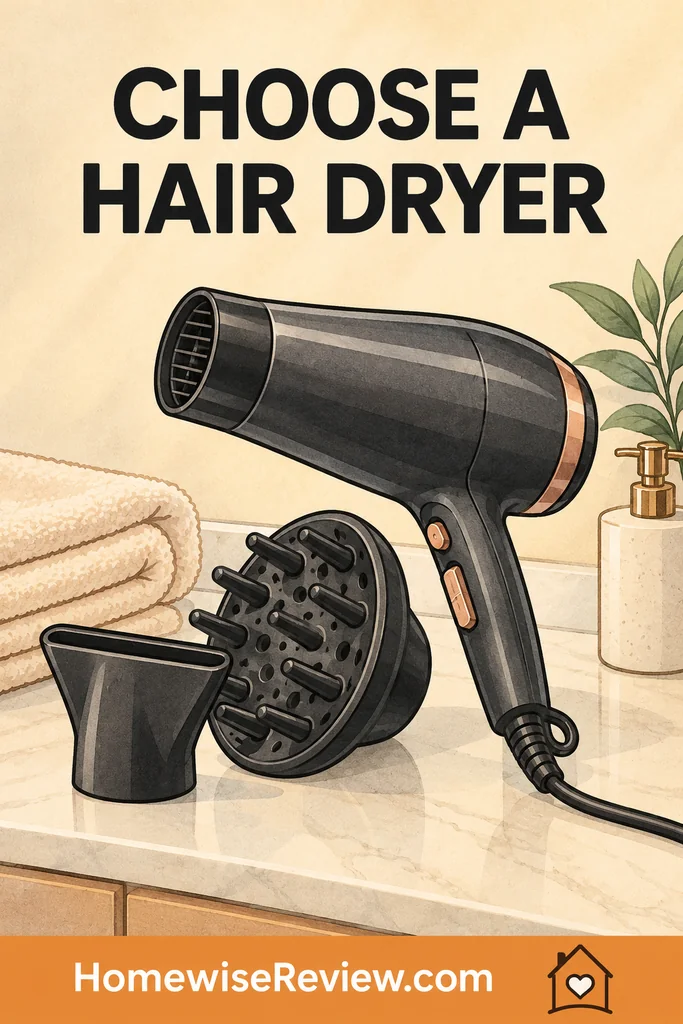
Choose a hair dryer by your hair type and styling goal first, then check four things on the spec sheet: heat and speed settings you can actually turn down, the attachments your style needs, how the dryer handles voltage and wattage, and immersion protection. Ionic, ceramic and wattage claims matter less than whether you can dry at a lower heat and keep the airflow moving.
How this guide was researched: HomeWiseReview researched and wrote this guide with AI tools on October 5, 2026, using a peer-reviewed study of hair dryer heat, American Academy of Dermatology (AAD) hair care guidance, the federal hair dryer immersion rule and a Conair 1875-watt dryer instruction booklet. It recommends no single dryer. Our product picks live in the lists linked below, and we have not tested dryers ourselves.
Start with the list that matches your hair
| If you | Check first | Our list |
|---|---|---|
| Have short hair | A concentrator for directing airflow; a size you can control | Hair dryers for short hair |
| Have fine hair | Low heat and low speed settings | Hair dryers for fine hair |
| Have curly or coily hair | A diffuser that fits the dryer you buy | Hair dryers for curly hair |
| Have thick hair | Airflow, durability and enough settings | Professional dryers for thick hair |
| Fight frizz | Ionic claims, a cool shot and low heat | Hair dryers for frizz control |
| Want an ionic dryer | What the maker says the ion feature does | Ionic hair dryers |
| Want a ceramic dryer | Heat settings, not just the ceramic label | Ceramic hair dryers |
| Want salon-style tools | Motor, attachments and cord | Professional hair dryers |
| Are on a budget | Settings, cool shot and a removable filter | Affordable hair dryers |
| Travel often | Dual voltage and folding size | Travel hair dryers |
| Need no cord | Run time and charging | Cordless hair dryers |
If you use a diffuser, our diffuser compatibility check of 30 dryers shows which dryers include one and which need a separate purchase.
Heat control matters more than the label
The AAD lists blow drying among habits that can damage hair. Its advice is to let hair air dry when possible, use the lowest heat setting, and use heat tools less often, aiming for once a week or even less. It also suggests wrapping wet hair in a towel to absorb water instead of rubbing it.
A 2011 study in the Annals of Dermatology adds an important nuance. Researchers shampooed and dried hair tresses 30 times under different conditions. Hair surfaces tended to become more damaged as the temperature increased, but the naturally dried group was the only one with damage to the cell membrane complex inside the hair. The authors concluded that using a dryer at a distance of 15 centimeters with continuous motion caused less damage than natural drying. In their setup, drying from 15 centimeters was listed at 47°C, compared with 95°C from 5 centimeters.
So the useful features are the ones that let you dry at lower heat: separate heat and speed buttons, a true low setting and a cool shot. The Conair instruction booklet checked for this guide gives the same technique: start at a lower setting, keep the dryer moving, direct airflow at hair rather than the scalp, and avoid concentrating heat on one section.
Wattage, voltage and your outlet
Wattage is the power a dryer draws (the watt is the SI unit of power). It is not a measure of airflow, so it cannot tell you on its own how fast a dryer will work on your hair. The Conair booklet, written for an 1875-watt dryer, warns that running it on the same circuit or fuse as other appliances may trip a 15 amp breaker or blow a 15 amp fuse, and says not to use an extension cord.
Voltage matters if you travel. The same booklet says standard dryers are designed to operate at 110 to 125 volts AC and tells owners not to use that model with a voltage converter. If you need a dryer abroad, choose one the maker rates for dual voltage; our travel hair dryer list focuses on those.
Ionic and ceramic: what the claims say
Ionic and ceramic are manufacturer technology names, so read them as claims. Conair’s booklet says the dryer’s negatively charged ions help reduce static electricity, control flyaways and add shine, and describes its titanium ceramic technology as infrared heat that dries hair “inside and out” and minimizes heat damage. Those are the brand’s descriptions, not measured results.
Either feature can be useful, but neither replaces heat control or technique. A dryer with an ion setting still needs a low-heat option and steady movement to fit the AAD and study findings above. Compare the picks in our ionic and ceramic lists if a specific technology matters to you.
Attachments and controls worth checking
- Concentrator: a narrow nozzle that focuses airflow. Conair’s booklet uses it with a round brush to pinpoint heat when straightening.
- Diffuser: spreads airflow for waves and curls. The Conair booklet suggests it for natural-looking waves. Fit varies by dryer, so check our diffuser compatibility study before buying one separately.
- Cool shot: a cool-air button, which Conair calls Cold Shot. Conair says finishing with it helps lock in a style.
- Separate heat and speed settings: the model in the booklet has 3 heat and 2 speed settings, which lets you lower heat without losing all airflow.
- Removable filter: the booklet says blocked or clogged air intake vents cause overheating, after which an automatic safety device shuts off the dryer or its heat. It says to unplug and let the dryer cool for 10 to 15 minutes before restarting, and to clean lint from the intake.
Safety: check for immersion protection
Federal rules treat hand-supported hair dryers without integral immersion protection as a substantial product hazard (16 CFR 1120.3, which points to the UL 859 standard). On the Conair dryer checked here, that protection is an Appliance Leakage Circuit Interrupter (ALCI) with test and reset buttons on the plug. The booklet says it makes the dryer inoperable under some abnormal conditions, such as immersion in water, and tells owners to test it every time they use the dryer.
The same booklet warns that any hair dryer is electrically live even when the switch is off, and says to unplug it after use, never use it while bathing, and keep it where it cannot fall into a tub or sink. It also recommends installing GFCI protection if you must use a hair dryer in the bathroom. A hand-held dryer without immersion protection is a reason to keep shopping.
Final Thoughts
The best hair dryer for you is the one in the list that matches your hair, with a real low-heat setting, the attachment your style needs, the right voltage and immersion protection. Use the table at the top to jump to those picks, then use the checks above to compare the finalists.
Frequently Asked Questions
What wattage hair dryer should I buy?
Wattage is power draw, not a measure of airflow, so it should not be the deciding spec. Check heat and speed settings, attachments and voltage first. If you use an 1875-watt dryer, Conair notes that sharing the circuit with other appliances may trip a 15 amp breaker.
Is air drying better than blow drying?
Not always. The AAD recommends air drying when possible and the lowest heat setting when you use a dryer. A 2011 study found that drying from 15 centimeters with continuous motion caused less damage than natural drying, while higher temperatures increased surface damage.
Is an ionic or a ceramic hair dryer better?
Both are maker technology claims. Conair says ions reduce static and flyaways and that its ceramic technology uses infrared heat. Neither replaces a low-heat setting and steady technique.
Can I use my hair dryer in another country?
Only if the maker rates it for the local voltage. Conair’s booklet says standard dryers are designed for 110 to 125 volts AC and not to use that model with a voltage converter. Look for a dual-voltage travel dryer instead.
Sources
- American Academy of Dermatology: habits that can damage hair
- Lee Y, et al. Hair shaft damage from heat and drying time of hair dryer. Annals of Dermatology, 2011 (PubMed)
- Conair: 1875-watt hair dryer instruction booklet (PDF)
- eCFR: 16 CFR 1120.3, substantial product hazard list (hand-supported hair dryers)
- NIST Special Publication 811, chapter 4: SI units (the watt as the unit of power)